Happy Belated Birthday, George Washington!

Today, February 22nd, is the actual anniversary of George Washington’s birth in 1732.  In honor of the “Father of Our Country”, I’ve written the following description of the famous Gilbert Stuart “Lansdowne” portrait, painted in 1796.  There are four copies of this portrait.  The version I am describing is in the collection of the Smithsonian Institute and is in the National Portrait Gallery.  Information about the painting, including its history and the symbolism contained within is available at the Smithsonian’s National Portrait Gallery website accompanying a photo of its copy of the portrait.

Painted in oil, this full-length, portrait is eight feet high by five feet wide.  In it, George Washington, a white man portrayed nearly life-sized, is dressed almost entirely in black.  He stands tall, just to the right of center, between a table on the left and a red chair on the right.

Continue reading for a deeper dive into this highly detailed painting. (Approximately a six-minute read.)

Washington wears a loose, knee length black velvet coat with a high standing collar over black knee breeches, black hose that display shapely calves, and flat black leather shoes.  A white stock or cravat (a length of white linen) is wrapped around his neck and its lacy ends cascade down to the middle of his chest, visible between the open front panels of his coat and above the V-shaped top of his waistcoat.  More white lace glints and drips below the cuffs of the long sleeves of Washington’s coat.   Washington’s face is seen in a 3/4 view and is turned slightly to our left.   He wears a curly white wig on his head.  A portion of the large black bow securing the pigtail of his wig can be seen over his left shoulder.  The hairline of the wig sits atop Washington’s high forehead, with the hair swept back from his face in rows of tight waves.  The sides come down to the bottoms of his ears, covering them, and project gradually wider from his head in horizontal rows of tight curls, creating a slightly triangular silhouette to his head.  His complexion is pale and pink with ruddy red cheeks and a pale grey shadow surrounding his thin straight lipped mouth down to the soft jowls of his jaw.   There is a slight cleft at the base of his chin.  Washington’s nose has a high bridge and is long and straight. Washington’s blue eyes are deep set with hooded lids beneath grey eyebrows.  His gaze follows the leftward direction of his outstretched right arm.  The palm of his extended right hand is turned towards us.  Washington’s left arm is at his side.  His left hand rests just below the ornate, tasseled gold hilt of the sheathed dress sword worn at his waist.  His index finger points downward along the slender, dark shaft of the sword. His feet are planted shoulder width apart, the narrow toes of his buckled shoes pointing outward, forming a shallow V that opens toward us.

Washington stands in a grand space in front of a tan stone wall that rises to just below his shoulders.  Large columns as wide as Washington himself soar high above his head from atop the wall, although only the lower portions are visible behind him.  Red drapery billows between the columns, obscuring all but the base of the single column on the far left edge of the painting and going around the back of a double column on the right, behind Washington’s head and his left shoulder.  A triangular glimpse of blue sky with grey storm clouds can be seen below the muted red drapery between the columns.  To the right of the double column, a rainbow fills the sliver of sky. Below the double column, an armchair with a carved gold frame and red upholstery sits against the wall behind Washington. At the top of the golden oval frame of the seat back is a smaller oval containing a field of blue with small stars above a longer section of red and white vertical stripes.  The oval frame of the chair back is carved with stars. The table to the left of Washington, below his extended right arm, is covered with a variety of items sitting on a red cloth draped over its top.  Near the front edge of the table, on the left, is a gleaming silver inkwell in the shape of an open boat resting on the backs of two reclining hounds.  A dual inkwell shaped like a rectangular cabin with a slanted roof sits in the open top of the rounded boat shaped base.  A long white feathered quill pen stands in the inkwell.  To the right of the inkwell is a loosely rolled sheaf of papers.  Two tan leather-bound books with gold stamped spines stand behind the inkwell at the left edge of the painting.  A black tricorn hat with a curling black feather sits to the right of the books.  The dusky red drapery is folded up at the front corner of the table, exposing a glimpse of pink marble tabletop atop an elaborately carved and gilded apron with indistinct figurative panels and a leg in the form of a tapered reeded column topped with a capital of eagles.  Below the table, are more books.  Several are stacked to the left and blend into the red drapery while two more lean against the exposed table leg, their stamped spines visible to the left of the leg.  The floor is covered in a rug with a geometric and stylized floral pattern in shades of red, blue, green, and golden yellow.

“Rear Window” Program Notes, Part 1

For those of you who are coming to the CAPA Summer Movie Series screening of “Rear Window” on June 17th, here are descriptions of the courtyard and L.B. “Jeff” Jeffries apartment.

Most of the action in the movie occurs in various rear-facing apartments and is seen from the window of another rear-facing apartment across a courtyard enclosed by at least six buildings.

The apartment overlooking the courtyard belongs to L.B. “Jeff” Jeffries.  It features a large, rectangular bay window that is made up of five tall casement windows:  three across and one on either end. Casement windows are attached to the frame on the side and open out like a door.  In this case, the three windows across each have two tall, narrow panes that open outward like double doors.  The windows on the short sides have a single window that is hinged on the side of the frame that is against the building. The bottoms of the windows are roughly 30” from the floor and rise to the ceiling. This bay projects out from the side of Jeff’s building and allows him to see not just the buildings directly across from him but also the windows on the buildings at either end of the courtyard. 

The buildings are like puzzle pieces and fit together to create this contained outdoor space. Looking out the bay window to the left, just beyond a small tree, is a large red brick building with green fire escapes, downspouts, and green wooden trim around the doors and windows. This building extends from the back side of Jeff’s building to the street that fronts the buildings on the other side of the courtyard. A sliver of the street is visible through the alleyway between this building and the small, run-down, two-story grey house directly opposite Jeff’s apartment. The grey house has two apartments: one on the ground floor and another on the second. The second-floor apartment has a glass door, a large square window, and a smaller, higher bathroom window that overlook a wooden balcony with steps on the right that go down to the small yard behind the house. Between the left and middle columns of the balcony, a half-light door gives a glimpse into the downstairs apartment. Two tall double-hung windows are to the right of the door. To the right of the grey house is a larger, more modern red brick apartment house. Four stories of the building and the activity of people in the apartments on the ground and second floors are visible from Jeff’s windows. This building has cream colored trim around the casement windows and the fire escape at the left edge of the building. There is a terrace on the fourth floor, with a ladder extending down between two windows on the third floor to a fire escape landing that is the same width as the terrace. There is another fire escape landing on the second floor. The two landings are wide enough to be accessed by two narrow windows on both the second and third floors. The window to the left is at the end of the hallway inside the building; the one on the right gives a view into the apartment kitchens. There is an open doorway out to the garden on the ground floor. The apartments on the first, second and third floors are identical with rooms that connect like the cars on a train: a door from the hall opens into a small kitchen which opens to the living room which in turn connects to a bedroom and culminates in a bathroom. These are visible through the narrow window to the left of the hallway window, a wide picture window flanked by narrow windows, a smaller double casement window and finally a small, high window. At the right end of the courtyard is a light grey building with blue trim around double hung windows. There is a balcony three stories above the courtyard. Beside it is another red brick building with chartreuse trim around the windows on the third story above a studio apartment with a wall of tall, slanted windows framed in black metal. More chartreuse trim adorns the edge of the balcony outside the studio apartment. The rest of the building is obscured by the light-yellow brick of a wall jutting out beside the right side of Jeff’s bay window. The yards and gardens for the various buildings are at different levels. The grey house and the apartment buildings on either side are on the same level, but the yard behind Jeff’s building is terraced with a basement level and a ground level reached by a flight of stairs. The yard is still close to six feet lower than the gardens of the buildings on the other side of the courtyard. And separated by a tall brick wall.

Jeff’s apartment is a studio with one room serving as bedroom, living room, and office. The front door, which opens out to the hall, is on the wall opposite the window and is at the top of three wide steps set within a niche about half the width of the main room. The wall to the right of the front door juts forward to the depth of the bottom step. The landing serves as a foyer with a low oriental trunk of pale wood with black iron fittings to the left of the front door. A tan runner half the width of the wide steps defines the path of traffic from the front door down into the main room.

The room itself is a good size and is filled with items from Jeff’s travels. Large black and white photos in plain, tan wood frames hang on the walls. There is with a small fireplace on the left wall and a large built-in bookcase with three vertical sections on the right. The bookcase wall separates the main room from the kitchen. A large mahogany table with turned legs sits against the front of the bookcase, covering the left and center sections, the short end of its rectangular top faces towards the windows. It’s top is cluttered with piles of 8 x 10 black and white photos and contact sheets. A tall lamp with a dark marbled base and wide white shade sits in at the rear of the table, in the corner formed by the front wall and the bookcase. A portable lightbox with a slanted front and a handle on top sits in front of the lamp. An 8 x 10 negative of a portrait of a woman is in the frame on the front of the box. A camera with a small flash attachment sits on the front corner of the table closest to the window, a battered leather satchel lays flat on the table behind it. Framed black and white photos in simple wooden frames rest on the desk, leaning against the bookcase. Two larger ones hang in the center section of the bookcase, where several shelves have been removed.

There is passageway into the kitchen between the end of the bookcase wall and the rear wall of the apartment, to the left of the window alcove. A piece of macrame fiber art hangs on the end of the bookcase. A stack of thick phone books and a wired black telephone with a round white dial sit on a small wooden table against the opposite wall. A black and white cylindrical light fixture that is narrower at the bottom hangs above the table.

Jeff sits in a brown leather and polished chrome wheelchair in a niche created by the end of the window bay and the twin bed that is tucked lengthwise into the bay beneath the windowsill. Several pillows are stacked at the head of the bed, which is against the right wall of the window bay. A pendant lamp pale with a broad, pale yellow, pleated shade dangles from the ceiling beside the head of the bed.

Just past the bed, another oriental cabinet rests against the wall outside the rectangular recess. On top of the cabinet, is a tray holding assorted brass containers. Still more black and white photos in plain, pale wood frames hang over the cabinet and more still on either side of the fireplace where they flank a large, colorful abstract still life in a broad white frame hung over the crowded mantel. Small sculptures, notebooks, and envelopes fill the spaces in between round mantle clock with its extended base and the brass candlesticks that stand at either end of the petite mantelshelf.

A celadon green, Chinese urn-shaped lamp and a brass ashtray sit on a low dark wood table with shelves to the right of the fireplace. A dark taupe club chair sits in front of the table, facing the windows and the bed. Also in the center of the room, a modern yellow wooden chair with a spindled back and curved headrail is angled, facing the bed and the club chair, creating a triangular conversation area. Just beyond the lamp, to the right of the fireplace is the door into the bathroom. The steps to the landing and front door are just beyond the right side of the bathroom door frame.

On the landing, a trench coat, camera bag, and a parka hang from hooks over the oriental cabinet. To the right of the cabinet, a furled umbrella leans against the front door frame. At the base of the steps, between the steps and the desk, is a mid-century modern cabinet in light wood with two flat circular gold knobs. Two large stacks of magazines are on top of this cabinet. Three more large photographs hang over the cabinet. A large yellow and dark taupe geometric-patterned area rug covers the wide dark floorboards in the center of the room.

Make Your Voice Be Heard!

In honor of the second annual Audio Description Awareness Day (April 16th) — I thought I would take this opportunity to share with you a post from the Audio Description Project (ADP) Listserv that was written by Fred Brack, the ADP Webmaster and Social Media Manager. For those of you who may never have heard of the Audio Description Project, it is an initiative of the American Council of the Blind and repository (and sometimes a catalyst) for all things audio description. Fred does a stellar job and you can check out the website here or use this URL: https://www.acb.org/adp/.

Fred’s post is about letting the FCC know what changes you would like to see to the Twenty-first Century Communications and Video Accessibility Act. So let’s celebrate our awareness of audio description by taking action!

The FCC Wants to Know What Changes You Want to the CVAA
(Twenty-First Century Communications and Video Accessibility Act)

As requested in this FCC Public Notice, the FCC would like to know what changes you feel are required in the 10-year old CVAA.  “Given changes in technology and industry practices, as well as taking into account consumer experiences, we seek comment on whether there is a need to update these rules.”  For example, we at the ADP suggest you consider the following.  Are enough shows described today on TV?  Are enough non-broadcast networks (USA, TBS, etc.) covered?  Are enough regions of the country covered?  Are cable TV providers able to supply the right equipment and answer your questions about AD?  Are you satisfied with the quantity and quality of audio description provided?

How about the streaming services?  The ACB has had to initiate legal action in many cases to get streaming companies to provide description.  Should the FCC mandate it for streamers of a certain size or type of content?  And once an audio description track is created, should there be some requirement that it must be passed along just like closed captioning is to any other service that picks up the show for rebroadcast?  These are just some of the things you should be thinking about.  And don’t simply rely upon someone else to voice these comments.  MAKE YOUR VOICE HEARD!  Historically, few blind or low vision individuals have replied to these Requests for Comment, which does not reflect well on the needs and desires of individuals with visual impairment.

How do you submit your comments to the FCC?  Here is the simplified process:

  1. Write your comments in a Word document, PDF, or plain text file.
  2. Go to this web address:  https://www.fcc.gov/ecfs/filings.
  3. Type the Proceeding Number in the first box:  21-140 and press Enter.
  4. The following fields are required on the form as you tab down:  Name(s); Primary Contact Email; Address Of (use “Filer” or “Author”); Address, City, State, Zip.
  5. At that point, the next field says to “Click or drop files here.”  You should be able to click to select your prepared comments, or drag and drop if you prefer.
  6. Click the box to receive an email confirmation of your submission.
  7. Finally you will click the button to “Continue to the Review Screen.”  (We haven’t done this yet, so we hope it is obvious from here on!)

There is an alternative.  If you want to type your comments directly, use this web address: https://www.fcc.gov/ecfs/filings/express.  The form is similar and slightly shorter, and you could cut-and-paste your comments into the Comment block if you wish.  As a last resort, you can send your comments to this address:  FCC504@fcc.gov.  In each case, remember that the Proceeding Number is 21-140.  DO IT NOW!

Fred Brack, fbrack@acb.org
ADP Webmaster and Social Media Manager

acb.org/adp *** facebook.com/acbadp *** twitter.com/ADPwebmaster

The Audio Description Project is an initiative of the American Council of the Blind

Description of a Crested Porcupine

F2419050-2BE9-416F-AC07-CB8849EABA1E

A black and white photograph of a crested porcupine against a white background.

The porcupine is seen head-on. Its small, lowered, V-shaped head is framed by its circular torso that is supported by its two stocky, short front legs. The legs are directly below the head and are close together with a small square of light between them.  There are four digits upon each foot. The porcupine’s long black and white quills bristle out and upward from its circular torso, past its forelegs, like the bristles of  a half-round hairbrush.  The quills are as long as the porcupine is tall.  Each quill is banded in stripes of black and white. Long white quills stand up along the top of its head. The rest of its torso is covered by short dark bristles.

The dark figure of the porcupine stands out vividly from the stark white background. The only shadow is a short black line between the bottoms of its two front paws. The long black and white needle-like quills create a staccato halo upon its back.

Happy Birthday, Louis Braille!

On this day two hundred and eight years ago Louis Braille, the man responsible for devising the system that bears his name of six dots to a cell for each letter of the alphabet, was born in a small village in France. But did you know that he was only a teenager when he did this groundbreaking work? The link below is to a half hour audio described and captioned docudrama video about Louis Braille:

https://www.youtube.com/watch?v=OFyY7u95nxw

When I Grow Up

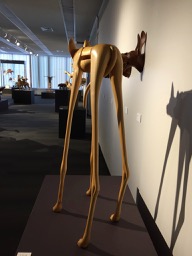
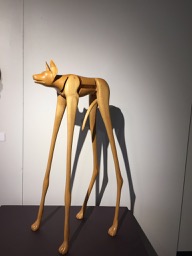
This past winter, I had the opportunity to design a touch tour and write verbal descriptions for an exhibit featuring the work of Ohio artist James Mellick.  Here is one of his more lighthearted dog sculptures.

Wooden sculpture of a little dog with very tall skinny legs.
When I Grow Up                     James Mellick jamesmellick.com

When I Grow Up, 2007

 Maple

 This abstract sculpture of a very small dog on very tall legs stands about 4’ high. The body looks like a breadbox on stilts. The four legs rise up as four separate elements and are joined by a rectangular mid-section of two pieces with a wide gap running horizontally along its side. The legs are slender and elongated with knees and elbows about a third of the way up from the floor. The muscles, tendons and joints in the legs are subtly indicated by the gentle swelling of the stick-like limbs that then flare out at the thighs and shoulders. They appear to have been stretched as if they were elastic. The four pad-like paws with their carved front toes standing squarely on the ground seem large given the thinness of the legs.  Behind each of the front legs, the dewclaws are represented by teardrop form attached at to the limb at its upper tapered neck and the globule hanging in high relief.

Two large bat-like ears resembling large pasta shells growing up from the back edges of the head mounted at the front end of the boxy body. The brow sits well below the ears. The muzzle tapers toward the blunt rectangular nose. The mouth is a narrow downward slit toward the bottom of the muzzle.

Rear view of a wooden sculpture of a very small dog on very tall skinny legs.
When I Grow Up  (rear view)  James  Mellick

At the other end, a long thin tail curls down and around the rump, between the hind legs, where it then arcs downward beneath the middle of the torso.

The shapes are very simplified and there is minimal detail. The surface is smooth and polished with a soft sheen.


A Piece Of History

Close up color photograph of a tall narrow vase on display in a gallery.
Wood-fired stoneware vase by Dick Cooter of Cooter Pottery.


This tall narrow vase stands 16” high and is 5” wide.  The body or lower portion is a little over half the height of the vase.  At the shoulder of the vase, just below the slightly tapered base of the neck, is a strip of clay that joins the neck to the cylindrical body.  It protrudes from the body like an uneven collar.  The bottom of this strip has a rough edge that appears to have been torn.   lug or knob has been pulled from this strip on either side. They stick out like little fingertips.  The tops of these lugs have a small depression as if made by a thumb pressing down while the clay was wet.  Two more lugs with holes in them are also on either side near the top of the neck, below the rim of the mouth. Uneven in size, the one on the right is a little bit longer than the one on the left.  They stick out like two small rectangular ears.

This vase is like a recording.  The depressions on the tops of the lugs at the shoulders, the rings banding the body and the neck, the splitting and cracking where the upper lugs and shoulder collar are attached, and the unevenness of the walls – they way they bow in and bulge outward – are all a record of the artist’s hands and the nature of clay.  The color of the vase is smoky and streaky with flares of lustrous coppery reds, greys and blacks as well as the surface textures that range from glossy to matte, smooth to rough are all reflective of the wood-firing process.

This vase is part of the audio described touch tour for the exhibit “For the Table” at the Ohio Crafts Museum.


Ginkgo Candelabra Set

IMG_5262 2
Ginkgo Candelabra Set by Matthew and Karine Maynard of Maynard Studios, Inc.

Above is a photograph of one of the pieces included in the audio described touch tours I recently did at the Ohio Crafts Museum for the Best of 2017 exhibit last month.  This was one of the pieces we had permission to touch.  The complete description, as given in the tour, is below:

Ginkgo Candelabra Set

Hand forged; mild steel land silicon bronze with walnut support base

Karine & Matthew Maynard

Lawrenceburg, KY

The artist’s words:

The Ginkgo tree has survived since the time of the dinosaurs and its leaves are beautiful in their grace and shape. This piece celebrates light and time by using the Ginkgo as a design motif and as a symbol of life.

This set consists of three pieces: a long, horizontal candelabrum that measures almost three feet wide and 14” high and two tall symmetrical candelabra that measure 12.5” wide and 40” high. All three pieces are 5.5” deep.

The low wide candelabrum sits on the front of the open display stand and is flanked by the two tall candelabra immediately behind. All three of the pieces consist of sinuous ribbons and tendrils of dull grey metal that swirl and curl around a more static form. On the long low piece, the form around which the tendrils travel is a thick arching vine or branch that rises from the far left and touches down several inches short of the far right edge where it curves gently upwards. Growing from the long the shoots that stem from the main arching vine are gold fan-shaped ginkgo leaves. They have a central vein and lightly scalloped arched tops. Their stems echo the left to right flow of the viny growth. Five small grey candle cups rest on five golden drip pans, like handle-less teacups on saucers, at varying heights along the length of the candelabrum.

The two tall candelabra are mirror images of each other so what is on the right side of one will be on the left side of the other. They each consist of a single straight rod-like element that is 40” high, the last 8” of which rise above a tangle of swirling tendrils. These tall forms begin as flattened triangular forms emerging from the base of the candelabrum, less than 1/2” thick. As they rise, the apex of the triangle is stretched upwards and the shape grows thinner and rounder until it becomes a slender rod topped by a candle cup and drip pan. Two more candle cups and drip pans perch on tendrils emerging from the twining growth: one to the outside of the tall rod several inches above the base and the other to the inside of that central rod, about halfway to the top. A few ginkgo leaves sprout from a curved shoot to the inside of the lowest candle cup. As in the low horizontal candelabrum, the main components are dark grey with antique gold accents in the ginkgo leaves and saucer.

All three pieces rest upon low walnut bases. The warm tones of the wood echo the warm notes of the gold accents. The gold saucers and leaves have a grayish patina so that the contrast between the two metals is muted. The metal itself has a hammered texture, tangible evidence of the artists’ tools.


We’re Off to Hear the Wizard (Redux)

I thought I’d share an article I wrote for the ACB Ohio’s newsletter last summer:

Last week, as I was preparing to provide live audio description for the CAPA Summer Movie Series presentation of “The Wizard of Oz” I was reminded of an episode from my childhood. Back in the dark ages, before we had streaming video, DVDs or even video cassettes, the annual broadcast of perennial favorites such as “The Wizard of Oz” was a very big deal. There were two nights a year our family ate on tray tables in front of the TV and one of those nights was when “The Wizard of Oz” was on.

One year I was being punished for some childhood transgression or other and I was not allowed to see “The Wizard of Oz”, which — for the sake of this tale — you should know I had seen several times before. However by the night of the broadcast, my mother was feeling sorry for me and allowed me to sit beside the closed door to the den, where my sister and father were watching the movie with the sound turned way up — on eleven, as the lads from Spinal Tap might say — while my mother kept me company in the kitchen. With the music, sound effects and dialogue as my cues I proceeded, from memory, to regale my mother with details of all the visuals I was missing. And so, upon reflection, I suppose that’s when my career as a nascent audio describer began…

Now to those of you familiar with audio description, this tale actually is a bit backwards with regards to how an audio describer works and for those of you who are not, allow me to explain. An audio describer creates a supplemental narrative by describing the visual details and actions in a movie or performance that would otherwise be inaccessible to audience members who are blind, low vision or otherwise visually impaired. Audio describers also describe art work and other types of exhibits in museums, parks, landmarks, educational materials, sporting events — pretty much any visual content you can think of. Audio description is just that: description. A good audio describer provides the imagery using language but does not interpret the material being described. It is our job to allow you, the audience, to have the story unfold with all of its nuances as the director intended and to experience art and exhibits so that you can draw your own conclusions.

So, what’s actually involved in creating audio description for a performance? The first thing that is necessary is to preview the performance or movie. Ideally I like to see something three times. The first time just to see it and understand the flow of the story and action. The second time is to make notes on the action and visual details and the third time, at least when I’m working on a film, is to work out the audio description in the context of the action. There’s a lot of stopping and starting when I work on a movie. Unfortunately when I work on a theatrical performance, my time line is very compressed. I generally preview the show one time, maybe four or five days prior to the performance I’ll be describing, before I begin writing the audio description and pre-show program notes. By getting a copy of the script in advance, I’m able to acquaint myself with the characters and the flow of the show before previewing. The night I’m in the theater I keep one eye on the stage and the other on my notebook as I scribble details about the costumes and sets. I supplement my notes with photos from the production’s website.

Unlike the pre-taped audio description you might hear on TV, at a live performance (or in the case of something like a movie festival where the audio description may be provided live) we have the luxury of spending the half hour prior to the show to give more detailed descriptions of the characters, costumes, scenery and sets as well as pertinent information from the printed program. These notes generally run less than half an hour and are repeated as time allows until the curtain goes up.

Between previewing, reading and writing my description, I generally spend at least 16 hours to prepare for a show. So when a venue requires that patrons make accommodation requests a certain length of time before a performance, please understand that they need time to locate an audio describer and the audio describer, once booked, needs time to prepare so that you can have the best possible experience.

Many venues provide audio description upon request as opposed to having a set performance time that will have audio description. You can always request audio description for a performance by calling the box office. If the box office cannot handle your request simply ask to whom you should speak and ask for the best way to contact that person. Many museums have audio descriptions of select items from their collections on their websites. The Audio Description Project has many resources listed on their website http://acb.org/adp/.

Don’t be afraid to request access. If you are already an audio description consumer, please be sure to give feedback to the theater (or museum or television station, etc) so that they understand what it means to you to have this access. You can do this either by posting on social media, making a phone call, sending an email or going old-school and sending a note via snail mail. If possible, try to get some feedback to the audio describer. We can provide better description when we have a better understanding of what our audience wants. Not everyone is the same, so not everyone may want the same level of detail and you may like some audio describers better than others. But, hey, that’s a horse of a different color!

Belated Happy Birthday, Helen Keller!

Happy Birthday Helen Keller: June 27, 1880

image001

Photo courtesy of the American Foundation for the Blind Helen Keller Archives

This 1955 black and white photograph shows Helen Keller, on her 75th birthday, assisted by Polly Thomson (secretary and companion) serving birthday cake.
In this black and white photograph, two older women stand shoulder to shoulder behind a lace covered table. On the table is a three-tiered cake decorated with icing flowers and swags and a single small slender lit candle. A stack of small plates with dark patterned rims sits to the left of the cake.

The woman on the left, Helen Keller, is a few inches taller than the woman on the right. Her face is cast slightly downwards. Her eyes are open yet her gaze is not fixed upon anything within the picture frame. Her is mouth opened in a smile. Helen’s dark wavy hair is parted on the left and pulled back from her face. Short waves of whiter hair flanking the part frame her face. Her light-colored damask, short-sleeved dress has a V-shaped neckline that is both wide and deep. It covers her shoulders and dips down to just above her breasts. She wears a triple strand of round white pearls around the base of her neck. Her right arm, bent at the elbow, reaches forward slightly as the broad bladed cake knife in her right hand poises between icing flowers atop the cake, its tip just behind the lone birthday candle. The knife obscures the writing on the far side of the candle but two words, one above the other, are visible on the near side: Birthday Helen.

The woman on the right, Polly Thomson, is wearing a darker dress of the same style and similar fabric except for the sleeves on which are fuller and pouf out at the banded cuff just above the elbow. Her hair is darker than Helen’s and is also worn in waves pulled off the face and parted on the left. With her chin tucked in, Polly’s head tips down toward the cake. Her downcast eyes direct our attention to the cake and the four hands of the women.

Both of Polly’s arms are held in towards her body and are bent at the elbows. Her right arm crosses in front of Helen’s left arm, seen just between the two women’s bodies and below Polly’s right elbow. Polly’s right hand reaches across Helen’s waist as she holds, her fingers gently grasping, the top of Helen’s right hand as Helen cuts the cake. Polly’s lower left arm crosses her body as she loosely holds Helen’s left hand in hers.

The touching right hands and forearms of the women create a V shape at Helen’s waistline, above and to the left of the cake. Their touching left hands and forearms create a smaller V shape, echoing the first, at Polly’s waistline. The down-turned heads and points of the V that are created by the hands direct our attention to the cake.

In the background on the left, behind Helen’s right shoulder, is a candle in a wall sconce. To the right of the sconce, we see the top left corner of the narrow black frame of a picture or document, the glare from the flash bulb obscuring its contents. In the lower left, below Helen’s right elbow the upper left of the dark wooden frame of a shield-backed chair is seen. Between the women and behind Polly on the right, are indistinct dark shadowy shapes resulting from the photographer’s flash.