Happy Belated Birthday, George Washington!

Today, February 22nd, is the actual anniversary of George Washington’s birth in 1732.  In honor of the “Father of Our Country”, I’ve written the following description of the famous Gilbert Stuart “Lansdowne” portrait, painted in 1796.  There are four copies of this portrait.  The version I am describing is in the collection of the Smithsonian Institute and is in the National Portrait Gallery.  Information about the painting, including its history and the symbolism contained within is available at the Smithsonian’s National Portrait Gallery website accompanying a photo of its copy of the portrait.

Painted in oil, this full-length, portrait is eight feet high by five feet wide.  In it, George Washington, a white man portrayed nearly life-sized, is dressed almost entirely in black.  He stands tall, just to the right of center, between a table on the left and a red chair on the right.

Continue reading for a deeper dive into this highly detailed painting. (Approximately a six-minute read.)

Washington wears a loose, knee length black velvet coat with a high standing collar over black knee breeches, black hose that display shapely calves, and flat black leather shoes.  A white stock or cravat (a length of white linen) is wrapped around his neck and its lacy ends cascade down to the middle of his chest, visible between the open front panels of his coat and above the V-shaped top of his waistcoat.  More white lace glints and drips below the cuffs of the long sleeves of Washington’s coat.   Washington’s face is seen in a 3/4 view and is turned slightly to our left.   He wears a curly white wig on his head.  A portion of the large black bow securing the pigtail of his wig can be seen over his left shoulder.  The hairline of the wig sits atop Washington’s high forehead, with the hair swept back from his face in rows of tight waves.  The sides come down to the bottoms of his ears, covering them, and project gradually wider from his head in horizontal rows of tight curls, creating a slightly triangular silhouette to his head.  His complexion is pale and pink with ruddy red cheeks and a pale grey shadow surrounding his thin straight lipped mouth down to the soft jowls of his jaw.   There is a slight cleft at the base of his chin.  Washington’s nose has a high bridge and is long and straight. Washington’s blue eyes are deep set with hooded lids beneath grey eyebrows.  His gaze follows the leftward direction of his outstretched right arm.  The palm of his extended right hand is turned towards us.  Washington’s left arm is at his side.  His left hand rests just below the ornate, tasseled gold hilt of the sheathed dress sword worn at his waist.  His index finger points downward along the slender, dark shaft of the sword. His feet are planted shoulder width apart, the narrow toes of his buckled shoes pointing outward, forming a shallow V that opens toward us.

Washington stands in a grand space in front of a tan stone wall that rises to just below his shoulders.  Large columns as wide as Washington himself soar high above his head from atop the wall, although only the lower portions are visible behind him.  Red drapery billows between the columns, obscuring all but the base of the single column on the far left edge of the painting and going around the back of a double column on the right, behind Washington’s head and his left shoulder.  A triangular glimpse of blue sky with grey storm clouds can be seen below the muted red drapery between the columns.  To the right of the double column, a rainbow fills the sliver of sky. Below the double column, an armchair with a carved gold frame and red upholstery sits against the wall behind Washington. At the top of the golden oval frame of the seat back is a smaller oval containing a field of blue with small stars above a longer section of red and white vertical stripes.  The oval frame of the chair back is carved with stars. The table to the left of Washington, below his extended right arm, is covered with a variety of items sitting on a red cloth draped over its top.  Near the front edge of the table, on the left, is a gleaming silver inkwell in the shape of an open boat resting on the backs of two reclining hounds.  A dual inkwell shaped like a rectangular cabin with a slanted roof sits in the open top of the rounded boat shaped base.  A long white feathered quill pen stands in the inkwell.  To the right of the inkwell is a loosely rolled sheaf of papers.  Two tan leather-bound books with gold stamped spines stand behind the inkwell at the left edge of the painting.  A black tricorn hat with a curling black feather sits to the right of the books.  The dusky red drapery is folded up at the front corner of the table, exposing a glimpse of pink marble tabletop atop an elaborately carved and gilded apron with indistinct figurative panels and a leg in the form of a tapered reeded column topped with a capital of eagles.  Below the table, are more books.  Several are stacked to the left and blend into the red drapery while two more lean against the exposed table leg, their stamped spines visible to the left of the leg.  The floor is covered in a rug with a geometric and stylized floral pattern in shades of red, blue, green, and golden yellow.
“Rear Window” Program Notes, Part 1

For those of you who are coming to the CAPA Summer Movie Series screening of “Rear Window” on June 17th, here are descriptions of the courtyard and L.B. “Jeff” Jeffries apartment.

Most of the action in the movie occurs in various rear-facing apartments and is seen from the window of another rear-facing apartment across a courtyard enclosed by at least six buildings.

The apartment overlooking the courtyard belongs to L.B. “Jeff” Jeffries.  It features a large, rectangular bay window that is made up of five tall casement windows:  three across and one on either end. Casement windows are attached to the frame on the side and open out like a door.  In this case, the three windows across each have two tall, narrow panes that open outward like double doors.  The windows on the short sides have a single window that is hinged on the side of the frame that is against the building. The bottoms of the windows are roughly 30” from the floor and rise to the ceiling. This bay projects out from the side of Jeff’s building and allows him to see not just the buildings directly across from him but also the windows on the buildings at either end of the courtyard. 

The buildings are like puzzle pieces and fit together to create this contained outdoor space. Looking out the bay window to the left, just beyond a small tree, is a large red brick building with green fire escapes, downspouts, and green wooden trim around the doors and windows. This building extends from the back side of Jeff’s building to the street that fronts the buildings on the other side of the courtyard. A sliver of the street is visible through the alleyway between this building and the small, run-down, two-story grey house directly opposite Jeff’s apartment. The grey house has two apartments: one on the ground floor and another on the second. The second-floor apartment has a glass door, a large square window, and a smaller, higher bathroom window that overlook a wooden balcony with steps on the right that go down to the small yard behind the house. Between the left and middle columns of the balcony, a half-light door gives a glimpse into the downstairs apartment. Two tall double-hung windows are to the right of the door. To the right of the grey house is a larger, more modern red brick apartment house. Four stories of the building and the activity of people in the apartments on the ground and second floors are visible from Jeff’s windows. This building has cream colored trim around the casement windows and the fire escape at the left edge of the building. There is a terrace on the fourth floor, with a ladder extending down between two windows on the third floor to a fire escape landing that is the same width as the terrace. There is another fire escape landing on the second floor. The two landings are wide enough to be accessed by two narrow windows on both the second and third floors. The window to the left is at the end of the hallway inside the building; the one on the right gives a view into the apartment kitchens. There is an open doorway out to the garden on the ground floor. The apartments on the first, second and third floors are identical with rooms that connect like the cars on a train: a door from the hall opens into a small kitchen which opens to the living room which in turn connects to a bedroom and culminates in a bathroom. These are visible through the narrow window to the left of the hallway window, a wide picture window flanked by narrow windows, a smaller double casement window and finally a small, high window. At the right end of the courtyard is a light grey building with blue trim around double hung windows. There is a balcony three stories above the courtyard. Beside it is another red brick building with chartreuse trim around the windows on the third story above a studio apartment with a wall of tall, slanted windows framed in black metal. More chartreuse trim adorns the edge of the balcony outside the studio apartment. The rest of the building is obscured by the light-yellow brick of a wall jutting out beside the right side of Jeff’s bay window. The yards and gardens for the various buildings are at different levels. The grey house and the apartment buildings on either side are on the same level, but the yard behind Jeff’s building is terraced with a basement level and a ground level reached by a flight of stairs. The yard is still close to six feet lower than the gardens of the buildings on the other side of the courtyard. And separated by a tall brick wall.

Jeff’s apartment is a studio with one room serving as bedroom, living room, and office. The front door, which opens out to the hall, is on the wall opposite the window and is at the top of three wide steps set within a niche about half the width of the main room. The wall to the right of the front door juts forward to the depth of the bottom step. The landing serves as a foyer with a low oriental trunk of pale wood with black iron fittings to the left of the front door. A tan runner half the width of the wide steps defines the path of traffic from the front door down into the main room.

The room itself is a good size and is filled with items from Jeff’s travels. Large black and white photos in plain, tan wood frames hang on the walls. There is with a small fireplace on the left wall and a large built-in bookcase with three vertical sections on the right. The bookcase wall separates the main room from the kitchen. A large mahogany table with turned legs sits against the front of the bookcase, covering the left and center sections, the short end of its rectangular top faces towards the windows. It’s top is cluttered with piles of 8 x 10 black and white photos and contact sheets. A tall lamp with a dark marbled base and wide white shade sits in at the rear of the table, in the corner formed by the front wall and the bookcase. A portable lightbox with a slanted front and a handle on top sits in front of the lamp. An 8 x 10 negative of a portrait of a woman is in the frame on the front of the box. A camera with a small flash attachment sits on the front corner of the table closest to the window, a battered leather satchel lays flat on the table behind it. Framed black and white photos in simple wooden frames rest on the desk, leaning against the bookcase. Two larger ones hang in the center section of the bookcase, where several shelves have been removed.

There is passageway into the kitchen between the end of the bookcase wall and the rear wall of the apartment, to the left of the window alcove. A piece of macrame fiber art hangs on the end of the bookcase. A stack of thick phone books and a wired black telephone with a round white dial sit on a small wooden table against the opposite wall. A black and white cylindrical light fixture that is narrower at the bottom hangs above the table.

Jeff sits in a brown leather and polished chrome wheelchair in a niche created by the end of the window bay and the twin bed that is tucked lengthwise into the bay beneath the windowsill. Several pillows are stacked at the head of the bed, which is against the right wall of the window bay. A pendant lamp pale with a broad, pale yellow, pleated shade dangles from the ceiling beside the head of the bed.

Just past the bed, another oriental cabinet rests against the wall outside the rectangular recess. On top of the cabinet, is a tray holding assorted brass containers. Still more black and white photos in plain, pale wood frames hang over the cabinet and more still on either side of the fireplace where they flank a large, colorful abstract still life in a broad white frame hung over the crowded mantel. Small sculptures, notebooks, and envelopes fill the spaces in between round mantle clock with its extended base and the brass candlesticks that stand at either end of the petite mantelshelf.

A celadon green, Chinese urn-shaped lamp and a brass ashtray sit on a low dark wood table with shelves to the right of the fireplace. A dark taupe club chair sits in front of the table, facing the windows and the bed. Also in the center of the room, a modern yellow wooden chair with a spindled back and curved headrail is angled, facing the bed and the club chair, creating a triangular conversation area. Just beyond the lamp, to the right of the fireplace is the door into the bathroom. The steps to the landing and front door are just beyond the right side of the bathroom door frame.

On the landing, a trench coat, camera bag, and a parka hang from hooks over the oriental cabinet. To the right of the cabinet, a furled umbrella leans against the front door frame. At the base of the steps, between the steps and the desk, is a mid-century modern cabinet in light wood with two flat circular gold knobs. Two large stacks of magazines are on top of this cabinet. Three more large photographs hang over the cabinet. A large yellow and dark taupe geometric-patterned area rug covers the wide dark floorboards in the center of the room.

Time to Space-out!

How cool is this? Not only do the folks working with the James Webb Telescope images want to make theses incredible images accessible to everyone, they’ve actually taken steps to do so! You can listen to the less than 2 minute NPR story “Alt text helps the visually impaired experience the James Webb Telescope images” here: https://one.npr.org/i/1112878868:1112878869

Biden admin announces at-home Covid tests for blind and low-vision people – CNNPolitics

I just read this in the CNN Coronavirus Update newsletter:

The Biden administration on Thursday rolled out free at-home Covid-19 tests that are designed to be more accessible for people who are blind or visually impaired.
— Read on www.cnn.com/2022/06/23/politics/blind-low-vision-accessible-covid-tests/index.html

I’m curious to know if an audio described version of the instructional video is available.

An Art Institution That Talks The Talk And Walks The Walk

I am thrilled to share news of an accessible event at the Wexner Center for the Arts. As this is a blog about audio description, I’d like to point out the audio described version of the event is available for streaming this week. All of the details are below in the email I received from Helyn Marshall. Kudos to Helyn and the staff at the Wexner for their attempts to make art truly available to everyone!

Here are all the details as outlined in Helyn’s email:

Dear Accessibility Professionals, Practitioners, and Friends,

I am writing to share some fast-breaking news on the accessibility front for Film/Video offerings at the Wex!

Starting tonight, we’re showing the new documentary film Her Socialist Smile, which shares Helen Keller’s work as one of the most passionate activists and advocates of her time, including an open captioned, in-person screening at 7pm on Wednesday, September 22.


In an exciting example of the continued expansion of our accessibility efforts, we are also streaming the Audio Descriptive Version of Her Socialist Smile (which the Wex provided seed money for the creation of the AD Track) for one week only, beginning today. 


Here’s a neat blog article Expanding access for Her Socialist Smile written by Chris Stults, Associate Film/Video Curator for the Wex, that shares how he found the film and its director, and helped to line up the support for the creation of an AD version of the film, which we are so happy to be able to share on our site with descriptive transcript available, in a pay-what-you-can model for greater accessibility for all.


This all very literally just came together yesterday; apologies that I couldn’t share with a little more notice, but I would so appreciate it if you could give this film a signal boost via social media or through your networks. Her Socialist Smile is a beautiful documentary and something that I’m really pleased the Wex could help support expanded access to.


With care,

Helyn 


Helyn Marshall

Accessibility Manager

Digital Accessibility Coordinator

wexner center for the arts

614-688-3890


Pronouns: she/her/hers | Why Pronouns Matter

Make Your Voice Be Heard!

In honor of the second annual Audio Description Awareness Day (April 16th) — I thought I would take this opportunity to share with you a post from the Audio Description Project (ADP) Listserv that was written by Fred Brack, the ADP Webmaster and Social Media Manager. For those of you who may never have heard of the Audio Description Project, it is an initiative of the American Council of the Blind and repository (and sometimes a catalyst) for all things audio description. Fred does a stellar job and you can check out the website here or use this URL: https://www.acb.org/adp/.

Fred’s post is about letting the FCC know what changes you would like to see to the Twenty-first Century Communications and Video Accessibility Act. So let’s celebrate our awareness of audio description by taking action!

The FCC Wants to Know What Changes You Want to the CVAA
(Twenty-First Century Communications and Video Accessibility Act)

As requested in this FCC Public Notice, the FCC would like to know what changes you feel are required in the 10-year old CVAA.  “Given changes in technology and industry practices, as well as taking into account consumer experiences, we seek comment on whether there is a need to update these rules.”  For example, we at the ADP suggest you consider the following.  Are enough shows described today on TV?  Are enough non-broadcast networks (USA, TBS, etc.) covered?  Are enough regions of the country covered?  Are cable TV providers able to supply the right equipment and answer your questions about AD?  Are you satisfied with the quantity and quality of audio description provided?

How about the streaming services?  The ACB has had to initiate legal action in many cases to get streaming companies to provide description.  Should the FCC mandate it for streamers of a certain size or type of content?  And once an audio description track is created, should there be some requirement that it must be passed along just like closed captioning is to any other service that picks up the show for rebroadcast?  These are just some of the things you should be thinking about.  And don’t simply rely upon someone else to voice these comments.  MAKE YOUR VOICE HEARD!  Historically, few blind or low vision individuals have replied to these Requests for Comment, which does not reflect well on the needs and desires of individuals with visual impairment.

How do you submit your comments to the FCC?  Here is the simplified process:

  1. Write your comments in a Word document, PDF, or plain text file.
  2. Go to this web address:  https://www.fcc.gov/ecfs/filings.
  3. Type the Proceeding Number in the first box:  21-140 and press Enter.
  4. The following fields are required on the form as you tab down:  Name(s); Primary Contact Email; Address Of (use “Filer” or “Author”); Address, City, State, Zip.
  5. At that point, the next field says to “Click or drop files here.”  You should be able to click to select your prepared comments, or drag and drop if you prefer.
  6. Click the box to receive an email confirmation of your submission.
  7. Finally you will click the button to “Continue to the Review Screen.”  (We haven’t done this yet, so we hope it is obvious from here on!)

There is an alternative.  If you want to type your comments directly, use this web address: https://www.fcc.gov/ecfs/filings/express.  The form is similar and slightly shorter, and you could cut-and-paste your comments into the Comment block if you wish.  As a last resort, you can send your comments to this address:  FCC504@fcc.gov.  In each case, remember that the Proceeding Number is 21-140.  DO IT NOW!

Fred Brack, fbrack@acb.org
ADP Webmaster and Social Media Manager

acb.org/adp *** facebook.com/acbadp *** twitter.com/ADPwebmaster

The Audio Description Project is an initiative of the American Council of the Blind

Helen Keller and Me

Two years ago today, I launched this blog. Today is also Helen Keller’s birthday, so Helen Keller and I have at least one thing in common. In honor of the anniversary of Helen Keller’s birth and this blog, here is an encore of my second blog entry (posted two years ago tomorrow):

Happy Birthday Helen Keller: June 27, 1880

image001

Photo courtesy of the American Foundation for the Blind Helen Keller Archives

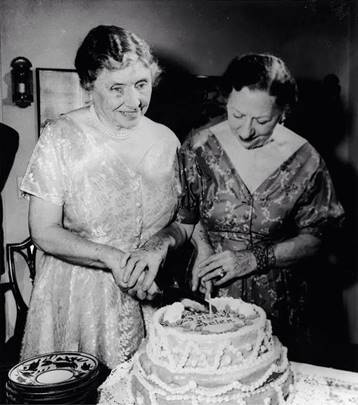
Above is a 1955 black and white photograph of Helen Keller, on her 75th birthday, assisted by Polly Thomson (secretary and companion) serving birthday cake.

In this black and white photograph, two older women stand shoulder to shoulder behind a lace covered table. On the table is a three-tiered cake decorated with icing flowers and swags and a single small slender lit candle. A stack of small plates with dark patterned rims sits to the left of the cake.

The woman on the left, Helen Keller, is a few inches taller than the woman on the right. Her face is cast slightly downwards. Her eyes are open yet her gaze is not fixed upon anything within the picture frame. Her is mouth opened in a smile. Helen’s dark wavy hair is parted on the left and pulled back from her face. Short waves of whiter hair flanking the part frame her face. Her light-colored damask, short-sleeved dress has a V-shaped neckline that is both wide and deep. It covers her shoulders and dips down to just above her breasts. She wears a triple strand of round white pearls around the base of her neck. Her right arm, bent at the elbow, reaches forward slightly as the broad bladed cake knife in her right hand poises between icing flowers atop the cake, its tip just behind the lone birthday candle. The knife obscures the writing on the far side of the candle but two words, one above the other, are visible on the near side: Birthday Helen.

The woman on the right, Polly Thomson, is wearing a darker dress of the same style and similar fabric except for the sleeves on which are fuller and pouf out at the banded cuff just above the elbow. Her hair is darker than Helen’s and is also worn in waves pulled off the face and parted on the left. With her chin tucked in, Polly’s head tips down toward the cake. Her downcast eyes direct our attention to the cake and the four hands of the women.

Both of Polly’s arms are held in towards her body and are bent at the elbows. Her right arm crosses in front of Helen’s left arm, seen just between the two women’s bodies and below Polly’s right elbow. Polly’s right hand reaches across Helen’s waist as she holds, her fingers gently grasping, the top of Helen’s right hand as Helen cuts the cake. Polly’s lower left arm crosses her body as she loosely holds Helen’s left hand in hers.

The touching right hands and forearms of the women create a V shape at Helen’s waistline, above and to the left of the cake. Their touching left hands and forearms create a smaller V shape, echoing the first, at Polly’s waistline. The down-turned heads and points of the V that are created by the hands direct our attention to the cake.

In the background on the left, behind Helen’s right shoulder, is a candle in a wall sconce. To the right of the sconce, we see the top left corner of the narrow black frame of a picture or document, the glare from the flash bulb obscuring its contents. In the lower left, below Helen’s right elbow the upper left of the dark wooden frame of a shield-backed chair is seen. Between the women and behind Polly on the right, are indistinct dark shadowy shapes resulting from the photographer’s flash.

Google Doodle Celebrates Seiichi Miyake

As you probably know, Google highlights all sorts of interesting things with the artwork known as the Google Doodle at the top of their search page. Today’s animation (seen below) celebrates Seiichi Miyake, the Japanese inventor of the Tenji block — those blocks that have raised bars and bumps and create detectable warnings on the sidewalk, train platforms, etc. When you click on the animation, you are taken to a page that has stories from all over about Seiichi Miyake and his bumpy Tenji blocks.

Here is a description of today’s doodle:

A grey curb runs diagonally from the upper left corner to the center of the wide rectangular picture frame. A small area of dark grey, almost black, street with part of a white bar from a striped crosswalk is visible in the lower left corner of the image. On the other side of the curb are two rows of square yellow paving blocks with raised bumps. Beyond these pavers is a dark grey sidewalk. The grid of the sidewalk is interrupted a path of more yellow paving blocks. These yellow blocks have raised bars and are perpendicular to the swath of blocks with the bumps along the curb. The white ball and red tip of a white cane appears in the upper right corner of the image. As the cane sweeps from left to right, it is followed by a pair of feet wearing black sneakers with rounded white capped toes and laces. The feet, at the bottom of jeans-clad legs, approach the intersection of the blocks with the raised bars and the blocks with the raised dots. The cane continues to sweep back and forth as it points to the blue, red, ochre, and green letters that spell “GOOGLE” along the curb-side edge of the dotted blocks. As the feet meet and stop at the intersection of the blocks, the tip of the cane comes rest between their toes.

“All About Descriptive Audio”

Last month, I had the opportunity to join co-hosts Marlene Brisk, Elizabeth Clark on and fellow guests Shirley Roberts and Chuck Adkins on “Morning Exchange” on VOICEcorps radio to discuss audio description. The show, which originally aired on September 28th, is now available to listen to on demand. No subscription is necessary to stream live or on demand audio.

If you are not familiar with VOICEcorps, you should check out their website. It’s a great resource for anyone with low or no vision.

Audio Description on “Morning Exchange”

Tune in tomorrow morning (September 28th) to the Voicecorps show “Morning Exchange” where I and two other guests will be discussing audio description from both provider and consumer points of view.  Whether you are curious about audio description or already a fan, this show is for you!  If you do not have a radio or are not in the central Ohio area, you can listen online at https://online.voicecorps.org/listen.m3u. The show runs from 11 AM until noon.